
|
|
The Virtual Armchair General
|
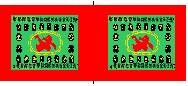
"IFD" Flags Information By the middle of 1860, as the Tai-P'ing Armies advanced on Shanghai, the European community began forming units to protect their trading interests. At first recruited from peoples from around the world otherwise unemployed in and around the city, it was quickly appreciated that the numbers necessary to confront the "Pingers" could only come by enlisting native Chinese, many of whom were refugees already. Unimpressed with the military capabilities of traditional Chinese units, these new formations were officered by Western volunteers and trained according to current practice with modern firearms. These Officers came from all over the world, not least America, but many would always be British. Ironically, it came to be understood that at least the Company level, the best Officers were frequently Native Chinese. Soon, the Imperial government began "licensing" these units to operate more or less independently in its service. Known collectively to the Chinese people as "Imitation Foreign Devils" (IFD's for convenience), many such units were raised over time, some of which never saw active duty, and others became more famous, perhaps, than their actual contributions to the ultimate Imperial victory deserved. As part of the Imperial desire to link the "Imitation Foreign Devils" to the regular establishment, each Commander's personal flag carried the Mandarin glyph equivalent to the first letter of his Western name. Because sources differ as to whether individual Battalion flags carried their Commander's name (glyph), the choice has been made to provide the Battalion Flags wherever possible both with the different Commander's glyph and without. A variety of Imperial Dragon Flags symbolizing the Unit's service to the Emperor were also attached to each IFD Unit, usually associated with its actual Commander when in the field. Players may choose one such flag for each IFD unit on your table top and by the differences allowed for, make it easier to identify units at a glance--not to mention making your miniature armies just that much more colorful! The "Ever Victorious Army" The first and most famous of these units was created by the American adventurer, Frederick Ward. Under him, the EVA received good training and experienced remarkable success, but after his death in action in 1862, its effectiveness varied. With the appointment of Major Charles George Gordon, RE, as subsequent Commander in 1863, the force expanded to its largest size, 6 Battalions (one designated a "Rifle Regiment") and a Commander's Bodyguard largely composed of "Manilamen" (Filipinos recruited from in and around Shanghai). At its largest, the EVA probably had no more than around 5,000 fighting men (many of them former Tai-P'ings), with perhaps 2,000 more coolies, boatmen, and others in support. Because Ward's personal flag carried the Character Hua ("Wah"), and later Gordon's showed a "Guh," both versions have been provided for the Battalion flags. Please note that Ward's immediate successors continued to use his flag, as indeed did Gordon until his own was adopted. Though their historical existence is uncertain, Company flags are available as a separate set, as are naval flags patterned after those illustrated in Augustus Lindley's narrative and in various other contemporary reproductions. The "Ever Triumphant Army" Formed at the behest of French interests in and around Ningpo over a year after the EVA, this force also relied upon a very mixed bag of peoples. Its Officer Corps varied as widely as the EVA and others, but the majority would always be French. Organizational information on the ETA is printed on the pages along with the flags themselves. We do not have a complete roster of officers who qualify for their own flags, but since many flags outlived their owners and manpower fluctuated constantly, we are confident a fairly complete ETA can be raised for any period. Since ETA commanders were sometimes promoted from Battalion officers we have arranged the flags such that each ETA commander has a regular Battalion flag and a Bodyguard flag. Only the current Officer commanding the ETA would have his name on the Bodyguard's flag. Each Battalion uses a flag with its own Officer's name, with the exception of the Companie des Europeens. Optional Battalion flags without characters are provided in case research proves these were used. Though their historical existence is uncertain, Company level
flags emblazoned with the Company number and Battalion Officer's name are also
available as separate Sets. Speculative naval flags, using the striped
tricolor pattern as used on uniform turbans, are provided as well. As surely as the membership of any "Imitation Foreign
Devil" unit was a very mixed bag, so were the other principal units
themselves. While there were many others, we have chosen to
represent only the following. Because some are so small, consisting of
Companies rather than Battalions, and sometimes had more traditional Chinese
military tendencies, the decision was made to provide "best guess"
Platoon flags as they may have appeared based on uniform colors
and Commander's names. Various extra Dragon Banners and boat flags are
included. Kingsley's Force Cardew's "Regiment of Disciplined Chinese" Macartney's Force Franco-Chinese Force of Kiangsu, 1861-63 ("Sikkaway Force") The Shanghai Volunteer Corps (a mixed European Militia) Dew's Force (later, the "Ever Secure Army") Return to 19th Century Chinese Flags Collection Main Page. Return to "Imitation Foreign Devils" Flags Page
| |

 FAVORITE LINKS